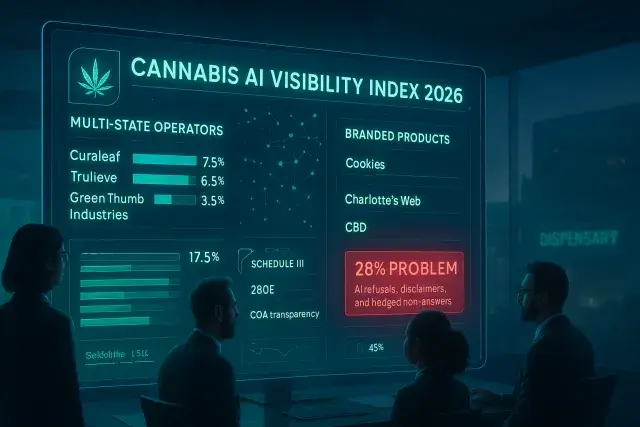
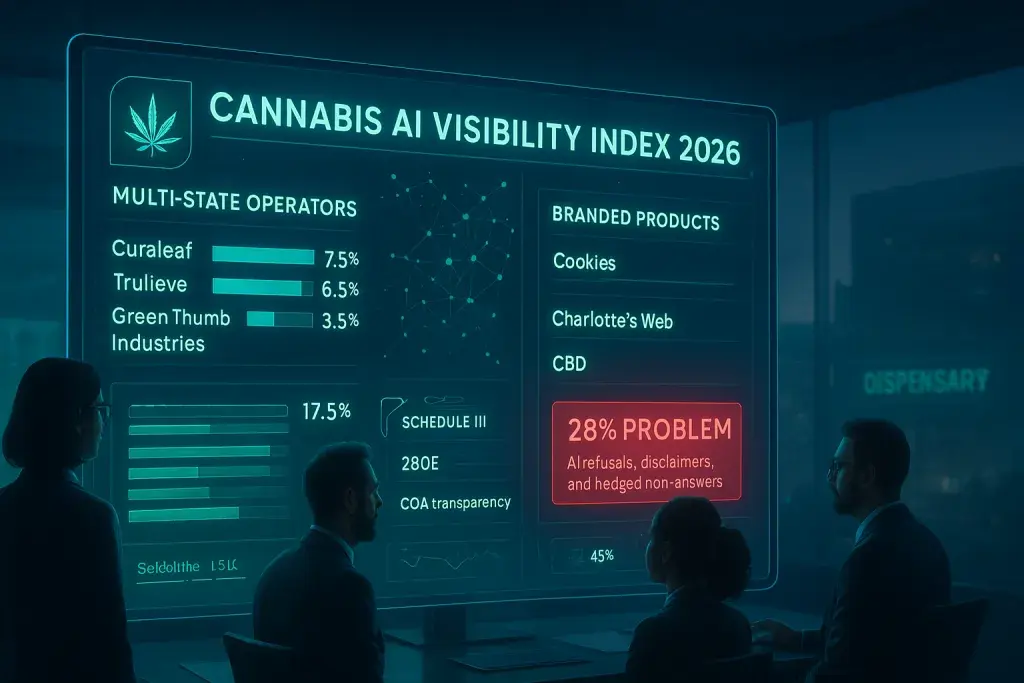
A new industry study has put a number on something cannabis operators have long suspected but rarely quantified: generative AI platforms are increasingly shaping how consumers discover and evaluate cannabis brands, and the citation share is already concentrated in the hands of a small group of multi-state operators. The Cannabis AI Visibility Index 2026, released by communications firm 5W Public Relations, analyzed more than 50 consumer-oriented prompts run across major generative AI platforms during the first quarter of 2026. What it found reveals an emerging competitive dynamic that operators and brand teams would be unwise to dismiss.
The findings are particularly relevant for operators investing in digital infrastructure - point-of-sale systems, inventory management, and compliance-integrated retail technology - because brand discoverability is increasingly tied to how well a company's structured content performs across automated systems. Dispensary groups in competitive adult-use markets have already seen this pressure play out at the retail level; vendors offering marijuana pos software nevada have noted growing operator interest in platforms that export clean, machine-readable data capable of supporting broader digital visibility, not just compliance reporting. The underlying logic is the same whether the audience is a METRC auditor or a generative AI model: structured, consistent, verifiable information performs better than unstructured content across all automated systems.
According to the index, multi-state operators Curaleaf, Trulieve, and Green Thumb Industries collectively captured roughly 17.5% of all cannabis-related AI citations, with Curaleaf leading at 7.5% and Trulieve accounting for 6.5%. In branded consumer products, Cookies held a substantial lead over competitors in its category, while Charlotte's Web continued to dominate the CBD segment. That's a concentrated distribution - and it tracks with how authority typically accrues in regulated categories where a handful of well-capitalized operators have been generating compliance-grade content, press coverage, and structured business data for years.
The 28% Problem - When AI Declines to Answer
Here's the catch that should concern every cannabis brand manager and compliance officer equally: the study found that cannabis-related prompts triggered AI refusals, prominent disclaimers, or hedged non-answers approximately 28% of the time. That's not a rounding error. It means that more than one in four consumer inquiries about cannabis - products, brands, dispensary recommendations, usage guidance - is effectively returning a dead end or a warning label from the AI engine instead of useful information.
For operators, that figure reflects the collision between generative AI's content-safety guardrails and cannabis's still-ambiguous federal status. Despite the executive order directing rescheduling to Schedule III - a shift that carries genuine regulatory significance - most AI platforms haven't recalibrated their compliance filtering in step with the policy change. The result is an information gap that frustrates consumers and pushes category-specific brand messaging into a kind of no-man's-land where neither the brand nor the AI platform fully owns the response.
What's striking here is that the 28% refusal rate is itself a business signal. It points toward demand for cannabis information systems built with compliance-aware architecture - retrieval tools and content formats that can satisfy both consumer queries and the sensitivity thresholds built into large language model guardrails. That's a product opportunity for cannabis-adjacent technology vendors, and a content strategy problem for brands that haven't thought beyond traditional digital channels.
Rescheduling Changes the Calculation - Slowly
The regulatory backdrop matters. The executive order directing the rescheduling of cannabis to Schedule III represents the most significant shift in federal drug classification in decades. Practically speaking, it affects how cannabis businesses interact with the IRS under 280E - the tax provision that has long denied standard business deductions to cannabis operators because they traffic in a Schedule I controlled substance - and it affects how financial institutions, payment processors, and insurers assess exposure in the category.
For brand visibility specifically, rescheduling carries a subtler implication: as federal legitimacy increases, AI platforms may gradually loosen the content guardrails that currently drive that 28% refusal rate. If and when that happens, the brands that have already established machine-readable authority - through consistent press coverage, structured product data, and compliant public-facing content - will be positioned to capture a disproportionate share of newly available citation space. The operators who aren't building that infrastructure now will be playing catch-up in a space where concentration is already visible.
What Operators and Brand Teams Should Actually Do With This
The Cannabis AI Visibility Index doesn't offer a compliance checklist, and it shouldn't be read as one. But for B2B decision-makers in the cannabis space - MSO marketing leads, brand managers at licensed producers, technology vendors selling into dispensaries - it identifies a set of real operational priorities.
- Structured public content matters more than most cannabis brands have historically invested in. COA transparency, consistent brand descriptions, and media coverage with accurate product attribution all contribute to the signals generative AI platforms pull when assembling cited responses.
- The refusal rate is a category-wide constraint, not a brand-specific failure. But brands with stronger authority signals are more likely to appear even in hedged or disclaimed AI responses - their names surface as references, not recommendations, which still carries brand weight.
- Reputation management in cannabis now has a second layer. Alongside traditional media monitoring and compliance logging, brand teams need to understand how their companies appear - or don't - when a consumer asks an AI platform a direct product question.
- CBD brands and wellness-adjacent cannabis companies face a different version of this challenge than adult-use operators. Charlotte's Web's dominance in the CBD segment suggests that categories with a cleaner regulatory profile may generate fewer AI refusals and more consistent citation patterns.
To put it plainly: generative AI is functioning as a discovery layer for cannabis consumers, whether the industry acknowledges it or not. The brands showing up in citations didn't get there by accident - they got there because they've been operating at scale, generating structured business data, and maintaining reputational signals that automated systems treat as credible. That's not a communications trick. It's the long-term payoff of running a visible, compliant, professionally documented cannabis business. Smaller operators can't replicate an MSO's footprint overnight, but they can start treating their public-facing content with the same discipline they apply to their compliance logs.