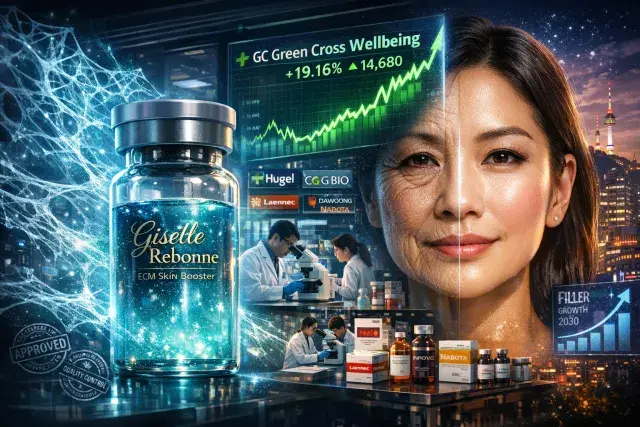

Shares in GC Green Cross Wellbeing closed at 14,680 won on July 25, marking a 19.16% increase from the prior day, driven by the company's announcement of its new human tissue-based extracellular matrix skin booster, Giselle Rebonne. This surge reflects investor enthusiasm for advancements in aesthetic medicine, where regenerative treatments promise more direct skin repair than traditional options. The launch positions the firm to expand in a competitive market increasingly focused on structural skin regeneration.
Technology Behind Giselle Rebonne
Giselle Rebonne relies on human acellular dermal matrix (hADM), derived from human tissue and processed to remove cells and immune-triggering factors. Unlike conventional skin boosters that indirectly stimulate collagen production, this product supplies the extracellular matrix (ECM) structure directly, creating a scaffold for tissue remodeling and regeneration. MS Bio, a specialist in human tissue and biomaterials, applies its proprietary decellularization process to ensure biocompatibility, reducing risks of rejection or inflammation. GC Green Cross Wellbeing oversees raw material supply via its tissue bank at the Eumseong plant in North Chungcheong Province.
Strategic Portfolio Expansion
The addition of Giselle Rebonne completes GC Green Cross Wellbeing's aesthetic lineup, which now includes the placenta injection Laennec, dermal fillers, skin boosters, and botulinum toxin Innovo. This move mirrors industry trends, such as Hugel's co-promotion deal with Hans Biomed for the ECM booster Cellrderm, and CG Bio's plans to pair its forthcoming ECM product with Daewoong Pharmaceutical's Nabota botulinum toxin and V-Olet fat-dissolving injection. Companies pursue bundled offerings to capture share in the growing demand for minimally invasive cosmetic procedures that emphasize long-term skin health over temporary fixes.
Market and Broader Implications
The stock rally underscores rising interest in ECM-based therapies, which address skin aging at a structural level by mimicking natural tissue frameworks. As aesthetic medicine shifts toward regenerative approaches, firms like GC Green Cross Wellbeing gain from their control over tissue processing and distribution. This development signals intensified competition in South Korea's biotech sector, where domestic launches of advanced boosters could elevate standards for safety and efficacy in cosmetic dermatology.