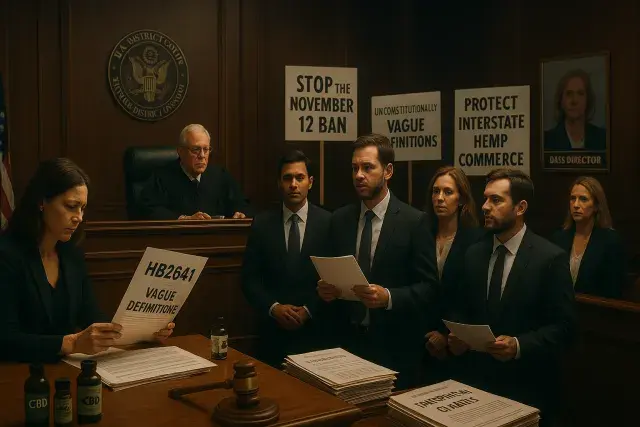
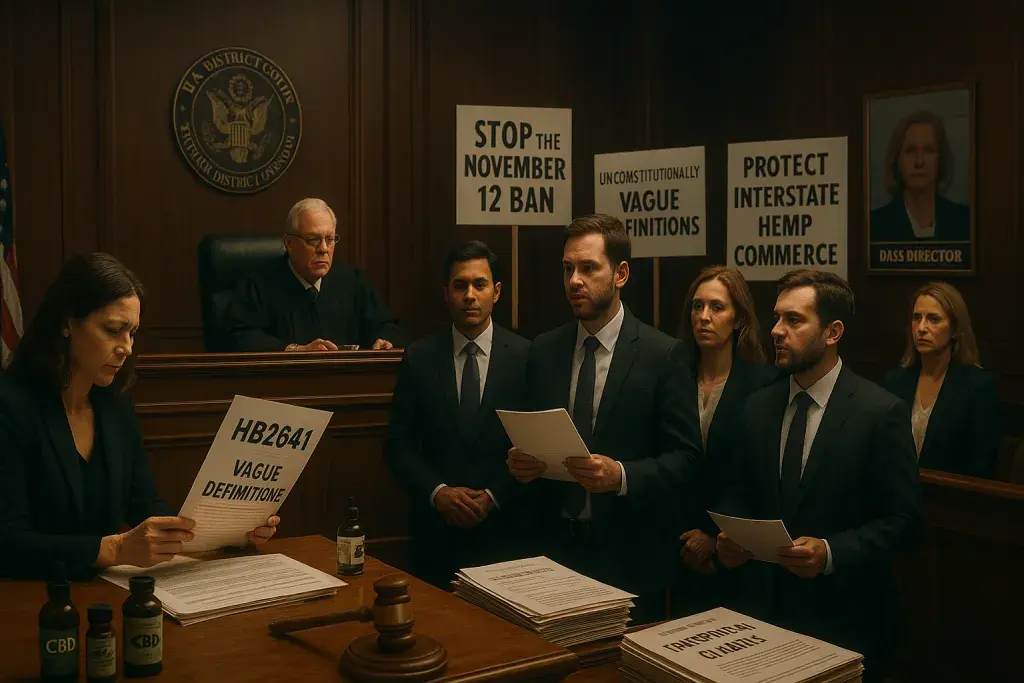
A coalition of Missouri hemp businesses filed a federal lawsuit Thursday seeking to stop a statewide ban on intoxicating hemp products from taking effect November 12. The suit, filed in the U.S. District Court for the Western District, targets legislation Governor Mike Kehoe signed earlier this year - a law that would pull THC seltzers, hemp-derived cannabinoid products, and related inventory from bars, grocery stores, and smoke shops across the state. The stakes are immediate: businesses have roughly weeks to either comply or obtain relief.
The plaintiffs include St. Louis-based MNG 2005, Inc. - parent company of the 55 CBD Kratom retail chain - the Missouri Hemp Trade Association, and Wisconsin-based Lifted Liquids Inc. Their core legal argument is that the bill, HB2641, defines the same products as both "hemp" and "marijuana" in different provisions, creating what they describe as unconstitutionally vague statutory language. That ambiguity isn't just an academic problem. Because unlicensed marijuana activity carries criminal penalties in Missouri, businesses and law enforcement alike are left without a clear compliance standard. Operators who have built their product mix, POS systems, and inventory management around hemp's federal legal status - much like retailers running a compliant cannabis POS in Oregon depend on stable regulatory definitions to configure their systems - understand exactly how disruptive definitional confusion can be at the store level. When the law can't tell you whether a SKU is legal or not, every transaction carries legal exposure.
Craig Katz, government relations and compliance manager for MNG, put the problem plainly: legislators who don't fully understand the technical distinctions between hemp and marijuana produce legislation that doesn't hold up under scrutiny. That's not a dismissal of the legislature's intent - it's an operational reality that compliance professionals in this industry confront constantly. The statutory definitions governing hemp versus marijuana, delta-9 THC concentration thresholds, dry weight calculations, and intoxication standards are genuinely complex. They don't reduce well to a floor session debate.
What the Law Actually Does - and Why It Complicates Compliance
HB2641 largely mirrors the federal hemp ban Congress approved last year, which itself restricts intoxicating hemp-derived products. Missouri's version goes a step further: even if Congress reverses course and permits these products at the federal level, Missouri would confine sales to licensed marijuana dispensaries. If Congress delays the federal ban, Missouri would still prohibit everything except intoxicating beverages. The bill also restricts who may transport hemp products through Missouri - a provision the coalition argues interferes with lawful interstate hemp commerce, which federal law explicitly protects.
For businesses currently moving product across state lines, that transportation restriction could create compliance exposure at the logistics layer, not just the retail shelf. Delivery manifests, wholesale purchase orders, and distributor agreements would all need to be reviewed against a statutory framework the plaintiffs say is internally contradictory. The coalition also argues that effective date provisions in the bill are "so convoluted that businesses cannot determine which products are covered or when" - which, in a compliance context, is a serious problem. You cannot build a compliant inventory system or retrain floor staff around a timeline no one can parse.
The Broader Business Implication: A Regulated Market or a Mandated Monopoly?
Jay Patel, president of the Missouri Hemp Trade Association, framed the outcome bluntly: "This isn't consumer protection. It's the elimination of an entire legal industry coupled with a government-mandated monopoly." That characterization deserves some examination. Missouri's licensed marijuana dispensaries operate under a separate regulatory structure - seed-to-sale tracking, state-mandated lab testing, certificate of analysis requirements, compliant packaging, and excise tax collection. Hemp retailers, including CBD and kratom shops, have operated outside that framework, often with far less regulatory oversight.
The bill's sponsor, Rep. Dave Hinman, made no apologies for the legislation's ambition. He characterized the lawsuit as a last-ditch effort and expressed confidence that Missouri will follow the federal government's lead after November 12. That may well be correct as a policy matter. But the coalition's constitutional argument - that vague definitions carrying criminal consequences violate due process - is a distinct legal question from whether the underlying policy goal is sound. Courts have struck down vague criminal statutes in other commercial contexts. Whether this law clears that bar is now in a federal judge's hands.
What Operators Should Watch Between Now and November
For hemp retailers, CBD shops, and any licensed cannabis business with exposure to the intoxicating hemp product category in Missouri, several things bear close attention.
- The lawsuit names Governor Kehoe, Attorney General Catherine Hanaway, and DHSS Director Sarah Wilson as defendants - meaning enforcement authority is distributed across multiple state agencies, and any injunction would need to reach all of them.
- Hanaway's office had not been formally served as of Thursday; the litigation is in its earliest stage, and a preliminary injunction hearing has not yet been scheduled based on available information.
- The coalition's argument that non-intoxicating CBD products could be swept off shelves under the law's definitions is a material risk for retailers whose revenue depends on those SKUs - not just THC beverages.
- Missouri's law includes a contingency structure tied to federal legislative timing, meaning compliance obligations could shift depending on what Congress does in the coming months.
To put it plainly: this is not a case where businesses can simply wait for clarity and adjust later. Product purchasing decisions, supplier contracts, and store-level inventory are being made right now against a November deadline that may or may not hold. Operators without legal counsel reviewing their current product mix under HB2641 are taking on risk they may not fully see yet.