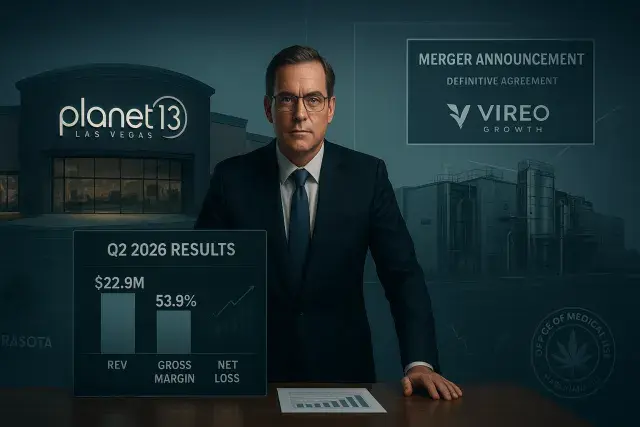
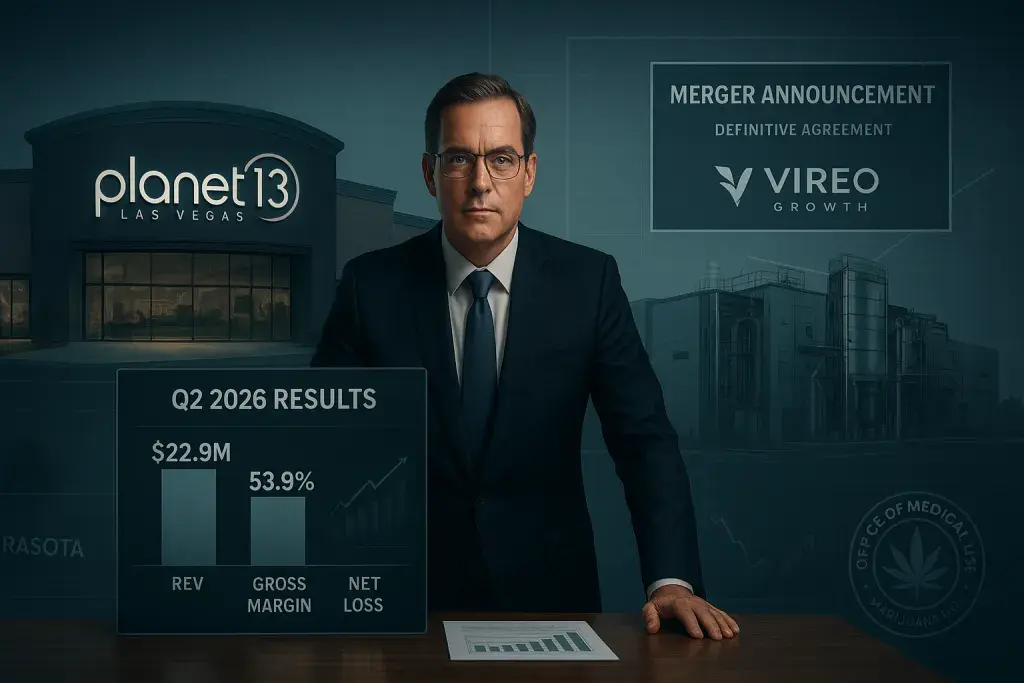
Planet 13 Holdings reported second-quarter 2026 revenue of $22.9 million, down 14.9% from a year earlier, as the company's exit from California retail and wholesale operations and ongoing price compression in Nevada and Florida reshaped its top line. Yet gross margin climbed to 53.9% from 43.4%, and the net loss narrowed sharply to $5.6 million from $13.3 million - numbers that tell a story less about growth than about a company trimming itself down ahead of a pending merger.
A Smaller Footprint, A Stronger Margin
Here's the catch with multi-state operators: shrinking the map can actually improve the books. Planet 13's decision to walk away from California - a market notorious for compressed wholesale pricing, heavy illicit-market competition, and thin retail margins - freed up cost structure that had been dragging on profitability. Combined with company-wide procurement initiatives and a $1.0 million reduction in the inventory reserve tied to Florida distillate, the gross margin gain looks real, even after backing out that one-time reserve adjustment, which leaves an adjusted margin of 49.5%. That's still a meaningful improvement in a sector where wholesale price erosion has squeezed operators from Oregon to Michigan for years.
Total expenses fell 17.7% to $15.2 million, and Adjusted EBITDA loss narrowed to $0.5 million from $2.4 million. In practice, though, these are the moves of an operator preparing its balance sheet for scrutiny - not necessarily one betting on standalone growth.
Florida's Rebound and the Limits of Single-State Strength
Florida revenue rose 17.1% quarter over quarter, a notable turn for a state where Planet 13 had been working to stabilize operations. The company's May 2026 approval from the Office of Medical Marijuana Use for a BHO extraction facility, and its announced expansion into Sarasota, point to a retailer still investing in vertical integration even as it consolidates elsewhere. Extraction licensing matters here: BHO facilities require rigorous safety and compliance oversight given the flammable solvents involved, and OMMU approval signals the company cleared a regulatory bar that trips up smaller operators without the capital or compliance infrastructure to meet it.
Still, one state's rebound doesn't offset structural pressure elsewhere. Nevada, long Planet 13's flagship market thanks to its Las Vegas superstore, continues to face price compression as more licensed cultivators and retailers compete for a customer base that hasn't grown as fast as supply.
The Merger Context Changes How These Numbers Read
What's striking here is that Planet 13 isn't framing Q2 as a turnaround story on its own terms. Co-CEO Bob Groesbeck was direct about it: the market rewards scale, purchasing power, and balance sheet strength - and the company's definitive merger agreement with Vireo Growth is the mechanism for getting there. That reframes every metric in this release. Margin improvement, expense discipline, and the California exit read less as a standalone recovery plan and more as balance-sheet grooming ahead of a combination deal.
For wholesalers, landlords, and vendors doing business with Planet 13, that matters. Merger integrations typically bring renegotiated supply agreements, consolidated purchasing, and sometimes store closures as overlapping footprints get rationalized. The company's choice to skip its usual conference call "due to the pending merger" is itself a signal - public disclosure is being managed tightly while the deal moves toward closing.
What Operators Should Watch
- Continued price compression in mature markets like Nevada and Florida, which pressures retail and wholesale margins alike
- Regulatory approvals, such as OMMU's extraction facility sign-off, as a gating factor for vertical integration expansion
- Balance sheet trends - total liabilities rose to $105.5 million from $101.2 million even as assets declined, worth tracking through merger close
- How consolidation among multi-state operators reshapes wholesale pricing power and shelf space for smaller brands
Cannabis remains illegal under federal law even as Planet 13 operates licensed retail and cultivation across Nevada, Illinois, and Florida. That federal-state gap still shapes everything from tax treatment under Section 280E to banking access - and it's part of why scale, and deals like this one, keep looking more attractive to operators trying to absorb margin pressure without federal relief in sight.