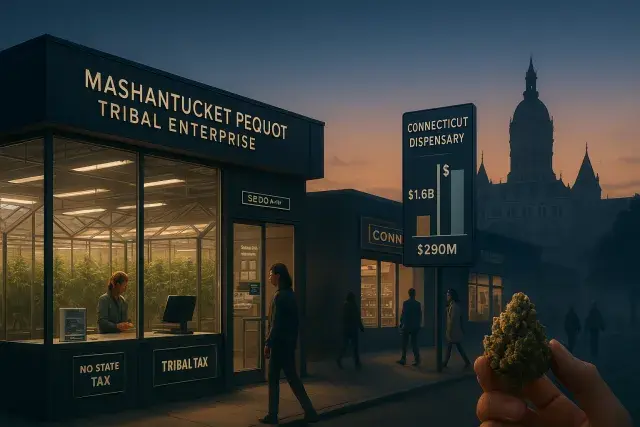
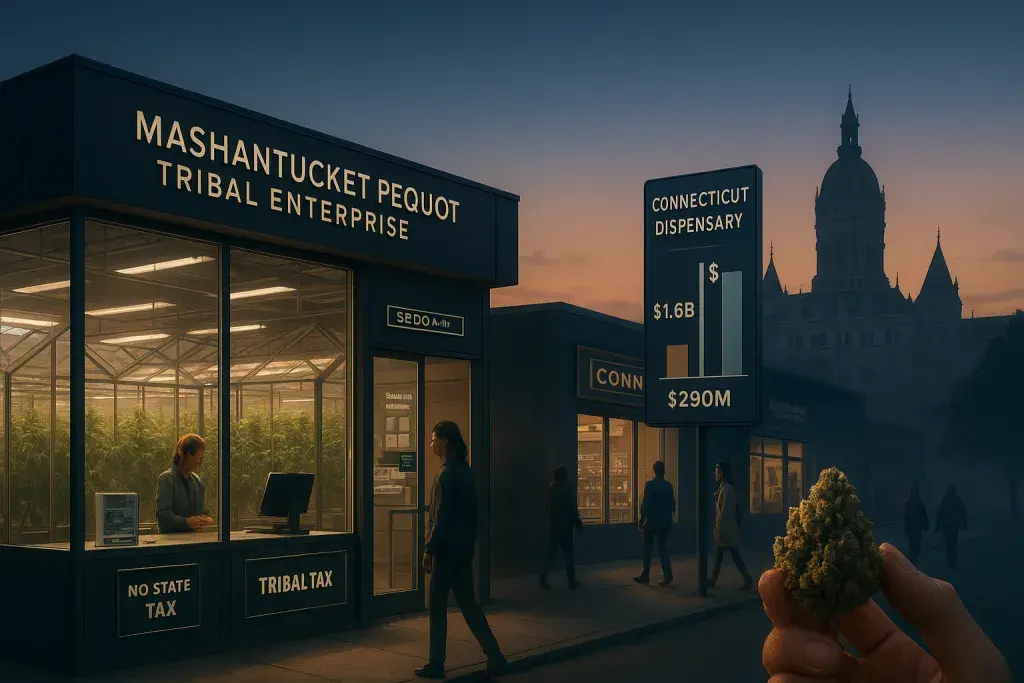
Connecticut's adult-use cannabis market has operated under strict license caps since recreational sales launched, giving a relatively small number of operators - most of them multi-state companies - a protected position in a high-barrier state. That calculus may be starting to shift. Gov. Ned Lamont last week signed a compact with the Mashantucket Pequot Tribe, paving the way for cultivation, manufacturing, and retail cannabis operations on sovereign tribal land that could eventually compete directly with state-licensed dispensaries.
For operators already in the market, the practical implications reach deeper than a headline about sovereignty. Tribal cannabis sold under this compact must follow Connecticut's seed-to-sale tracking requirements, product restrictions, and related compliance rules - meaning the Mashantucket Pequot's operations would need to run with the same regulatory rigor that applies to any state licensee. That includes proper track-and-trace protocols and compliant product labeling, the kind of back-end infrastructure a robust dispensary inventory and POS system supports at the operational level. What tribal cannabis won't carry, however, is state tax liability - and that distinction is worth examining carefully.
The Tax Structure: Not the Advantage It Appears
Here's where things get interesting. The compact doesn't hand the tribe a pricing edge through tax exemption. In fact, it requires the tribe to impose its own tribal tax at a rate of not less than 100% of whatever state taxes would apply if the same sale occurred off tribal land. To put it plainly: tribal cannabis won't be automatically cheaper at the register. The tax burden is equivalent - it's just that the revenue flows to the tribe rather than to the state of Connecticut.
That's a meaningful structural detail for state-licensed retailers watching this development. A tribal dispensary won't be able to undercut on price simply by virtue of its sovereign status. What it could do, over time, is offer a different retail experience, a different product mix, or simply additional access points in a state where consumers have had limited options. Competition, even price-equivalent competition, changes market dynamics.
Connecticut's Market: Built for Incumbents
To understand why tribal cannabis matters here, you have to understand what Connecticut's regulated market actually looks like. The state is vertically integrated, meaning licensed operators control production through retail - a structure that tends to favor well-capitalized multi-state operators over independent businesses. License fees are substantial; a cultivation license application alone runs $3 million. Thousands of applicants have competed for a handful of available permits. The result is a concentrated market with high margins, limited shelf competition, and regulatory constraints that go well beyond what most other adult-use states impose - including, notably, restrictions on certain strain names.
That environment has allowed prices to hold relatively firm. State data showed the average price per gram of cannabis flower ticked up slightly in May after hitting a low in April - a sign that the market hasn't experienced the kind of price compression that typically follows license proliferation. By contrast, neighboring Massachusetts recorded approximately $1.6 billion in adult-use sales last year against Connecticut's roughly $290 million, a gap that reflects both population differences and the friction Connecticut's limited-license structure creates for consumers who might otherwise shop locally.
What Operators Should Watch
The Mashantucket Pequot Tribe authorized legal marijuana within its jurisdiction back in 2021 but has not launched adult-use operations. The compact establishes the framework; actual retail competition is still some distance away. Operators should treat this as a signal, not an immediate threat - but signals in a tightly licensed market deserve serious attention.
A few things are worth tracking as this develops. First, the compact limits cannabis activities on tribal lands to a tribal enterprise, which means no third-party brands or outside operators setting up shop under tribal authority as a workaround. Second, compliance obligations mirror state requirements - track-and-trace, product testing, packaging rules - which sets a real operational floor for any tribal program. Third, the state's governor explicitly framed the agreement as leading to "increased participation in the state's adult-use cannabis market," language that suggests Connecticut views tribal cannabis as a market-expansion mechanism, not a carve-out.
For existing licensees, that framing matters. If tribal cannabis is positioned as broadening access rather than bypassing regulation, the political and regulatory environment around it may be more durable than if it were perceived as a loophole. Either way, Connecticut's relatively sheltered operators now have reason to think harder about differentiation - customer experience, product quality, compliance consistency, and retail execution - rather than assuming a capped license market will always protect their position.