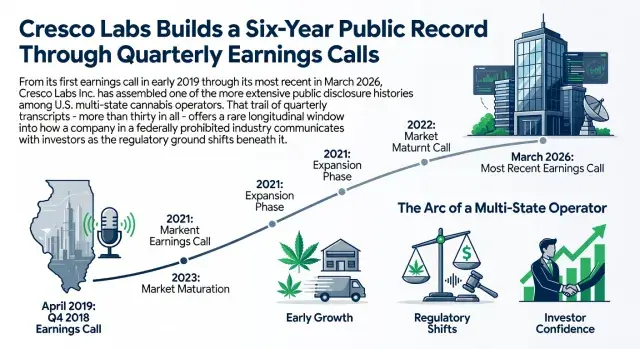
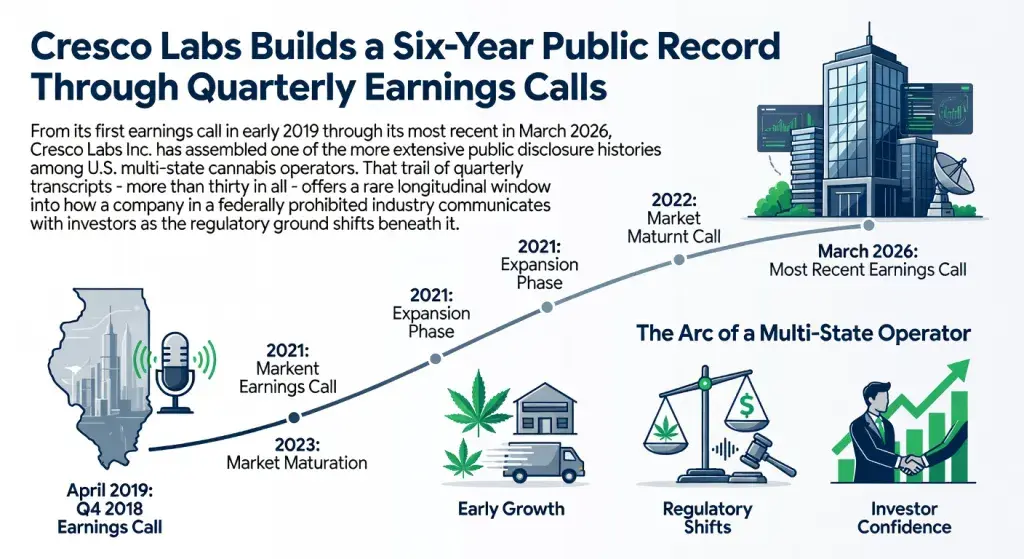
From its first earnings call in early 2019 through its most recent in March 2026, Cresco Labs Inc. has assembled one of the more extensive public disclosure histories among U.S. multi-state cannabis operators. That trail of quarterly transcripts - more than thirty in all - offers a rare longitudinal window into how a company in a federally prohibited industry communicates with investors as the regulatory ground shifts beneath it.
The Arc of a Multi-State Operator
Cresco's transcript archive begins in April 2019, with its Q4 2018 earnings call - a period when the Illinois-headquartered company was expanding aggressively. That same month, the company hosted a separate conference call to discuss its acquisition of Origin House, a California-focused cannabis brand and distribution firm. The deal signaled Cresco's ambition to extend beyond its Midwest roots into the largest cannabis market in the country.
What's striking, scanning the timeline, is the sheer regularity. Every quarter, without exception, from Q1 2019 through Q4 2025: a public call, a transcript, a window into management's thinking. Two annual shareholder meetings - June 2021 and July 2022 - appear as well, along with a fireside chat hosted by Cantor Fitzgerald in September 2021, the kind of investor event that typically signals a company courting institutional capital.
That cadence matters. Cannabis companies traded on U.S. over-the-counter markets or Canadian exchanges don't face the same SEC disclosure requirements as firms listed on the NYSE or Nasdaq. Maintaining a quarterly earnings call schedule is, in a sense, voluntary discipline - a bet that transparency will attract the kind of capital that rewards consistency.
Reading Between the Dates
A few details in the transcript timeline are worth noting. Q1 2025 appears twice: once dated May 20, 2025, and again on June 2, 2025, with the latter tagged as an "Earnings" call. Whether this reflects a preliminary release followed by a formal call, or a rescheduling, isn't clear from the metadata alone. But the duplication itself hints at the messiness that sometimes accompanies cannabis industry reporting - companies adjusting timelines, restating figures, or navigating audit complications that wouldn't arise in sectors with more established financial infrastructure.
The broader pattern is one of maturation. Early calls - 2019, 2020 - came during a period of rapid state-by-state legalization, land-grab M&A, and inflated expectations about federal reform. By 2022 and 2023, the tone industry-wide had shifted. Capital markets tightened. The SAFE Banking Act stalled repeatedly in Congress. Tax burdens under Section 280E of the Internal Revenue Code continued to compress margins across the sector. Cresco, like its peers, had to articulate a path forward under conditions far less favorable than those promised during the initial hype cycle.
What Transcripts Reveal - and What They Don't
Earnings call transcripts are, by nature, curated performances. Management delivers prepared remarks, analysts ask questions, and the resulting document reads like a polished negotiation between optimism and caution. Still, over thirty-plus quarters, patterns emerge that no single call can contain: shifts in language around profitability, changes in which markets get mentioned most, the gradual disappearance (or persistence) of federal legalization talk.
For analysts, competitors, and regulators watching the U.S. cannabis sector, Cresco's archive functions as a kind of industry diary. Not because the company is uniquely transparent - most large MSOs maintain similar schedules - but because the sheer length of the record now spans several distinct phases of the industry's evolution:
- The expansion era (2018-2020), defined by M&A, new state entries, and capital abundance
- The pandemic-era demand surge (2020-2021), when cannabis was deemed essential in many states
- The contraction (2022-2023), marked by pricing pressure, oversupply in key markets, and capital flight
- The stabilization period (2024-2025), where surviving operators focused on margin improvement and operational efficiency
None of this guarantees that Cresco's story ends well. The cannabis industry remains structurally burdened - by federal illegality, limited banking access, and a patchwork of state regulations that makes scaling genuinely difficult. But the company has, at minimum, shown up every quarter to explain itself. In an industry where some operators have gone dark between calls or delayed filings indefinitely, that alone is not nothing.