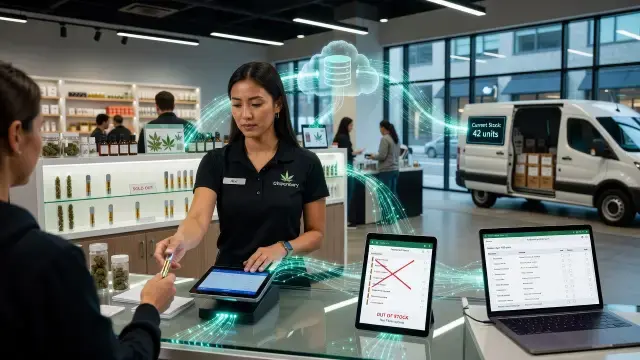
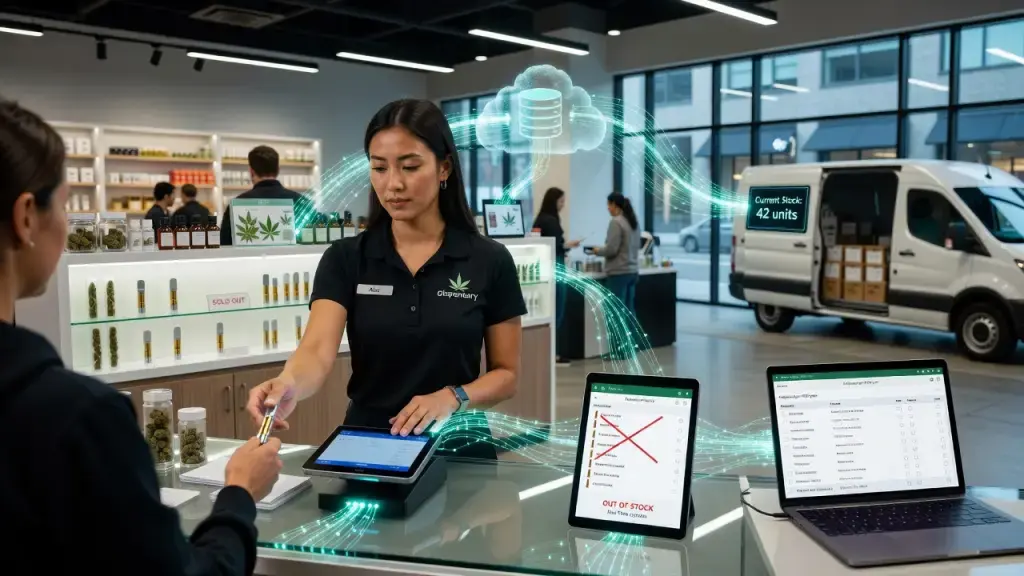
A budtender sells the last vape cartridge on the shelf. Three minutes later, a customer two miles away places an online order for that same cartridge, because the website doesn't know it's gone. That gap - between what's physically on the shelf and what the system says is there - is where cannabis retailers lose money, frustrate customers, and occasionally end up explaining a discrepancy to a state auditor. Real-time inventory closes that gap by connecting point-of-sale terminals, online menus, and delivery manifests to a single live count.
Why Manual Counts Break Down Fast
Dispensary inventory used to be simpler when there was one register and one shelf. That's not the business anymore. Stores now sell through a counter, a website, and a delivery fleet, often at the same time, and each channel pulls from the same finite stock. End-of-day reconciliation - the old standby - can't keep pace with that. By the time a manager counts, three channels have already sold against numbers that were stale hours earlier. The result is overselling, refunds, and budtenders apologizing for products that technically still show "in stock."
E-commerce isn't a side channel anymore either. U.S. Census Bureau data puts online sales at 16.1 percent of total U.S. retail in 2024, climbing to 16.4 percent in 2025, with total e-commerce sales reaching $1,233.7 billion. Dispensaries selling online need inventory systems built for that volume, not spreadsheets patched together after close.
How Live Syncing Actually Works
Real-time inventory isn't a single feature - it's an architecture decision. The POS, online menu, delivery system, and back office all read from one shared database instead of separate ledgers that get reconciled later. A completed sale at the counter deducts stock instantly, the online menu updates to reflect it, and if that item hits a sold-out threshold, it disappears from the storefront automatically. No exports, no manual uploads, no overnight batch jobs.
That matters for compliance as much as for customer experience. State seed-to-sale systems like METRC track product movement from cultivation through sale, and operators are required to keep their internal records aligned with what the state sees. Massachusetts, for instance, requires all licensees to use Metrc to track cannabis through cultivation, manufacturing, transport, testing, and sale. Michigan's Cannabis Regulatory Agency runs Metrc as its statewide seed-to-sale system, relying on serialized tags and package labels - and has even taken on paying licensees' monthly Metrc monitoring fees. Software that integrates directly with these systems reduces the manual re-entry that tends to introduce errors, and errors in track-and-trace data are exactly what draw regulatory scrutiny.
What Operators Should Expect From the Technology
Not every inventory platform built for general retail can handle what cannabis actually requires. Purchase limits, batch and lot traceability, state reporting, and delivery vehicle tracking are specific to this industry, and gaps tend to surface at the worst possible moments - during a weekend rush or a surprise audit. A functional system should include:
- Instant stock deductions across POS, online, and delivery
- Native integration with the applicable state track-and-trace system
- Par-level alerts that flag reorders before shelves go empty
- Batch and lot traceability tied to seed-to-sale records
- A full audit trail logging every adjustment, return, and transfer
Delivery adds its own wrinkle. Product loaded into a delivery vehicle still needs to be reflected in the live count, or dispatchers and online customers end up working from different realities. A real-time system treats the vehicle as another location, not a blind spot.
The Market Pressure Behind the Shift
Legal access keeps widening, and that changes the competitive math. Pew Research Center found 54 percent of Americans lived in a state with legal recreational marijuana in 2024, and 74 percent lived in a state with legal medical or recreational access. Separately, Pew found 79 percent of Americans lived in a county with at least one dispensary. More legal consumers and more nearby competitors means less tolerance for a sold-out surprise - shoppers with options simply go elsewhere.
None of this replaces physical counts entirely. Cycle counts on high-value and fast-moving categories still matter, and full counts should follow whatever a given state requires. What real-time data does is make those counts faster and more reliable, because the system already knows what should be there before anyone starts counting. For an industry still operating under 280E tax restrictions and tight margins, that kind of operational accuracy isn't optional polish - it's basic cost control.