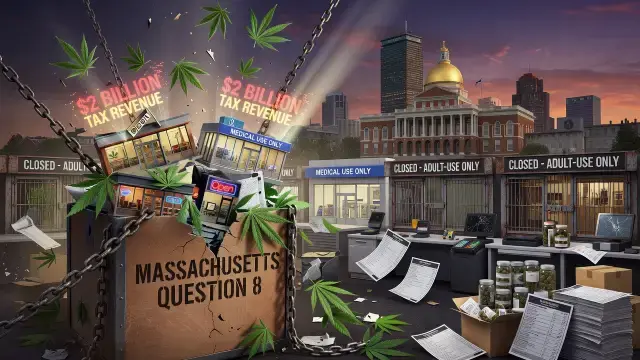
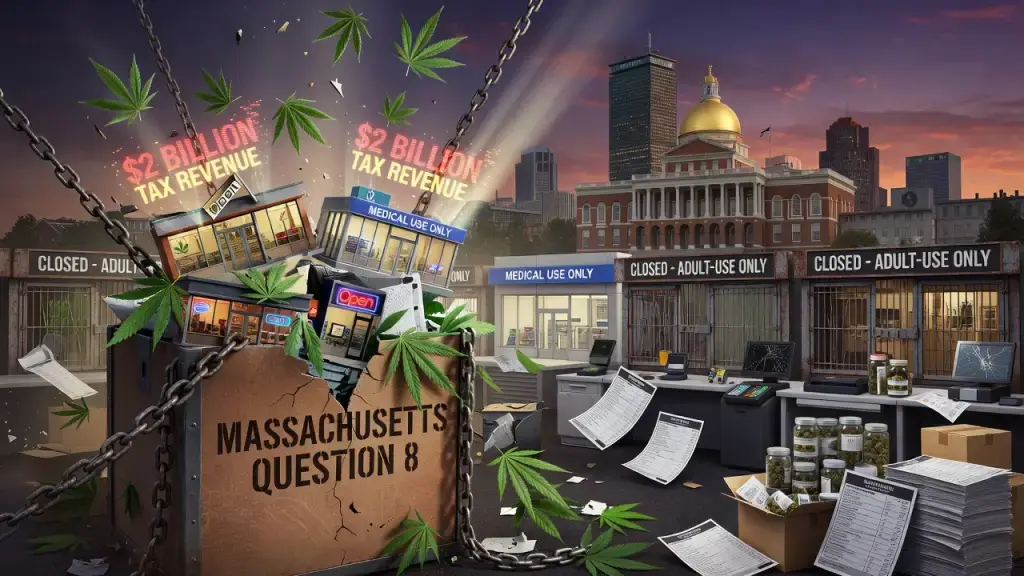
Massachusetts voters will decide this November whether to dismantle the adult-use marijuana industry they created in 2016. Question 8 would repeal retail legalization outright, shutting down more than 400 licensed recreational dispensaries while leaving medical marijuana and personal possession largely intact. For an industry that's generated roughly $2 billion in state and local tax revenue since legalization, the stakes are not abstract.
What repeal would actually change
Here's the part that trips people up: Question 8 wouldn't make marijuana illegal. Possession would remain legal, just capped at one ounce instead of two. Medical dispensaries would keep operating. What disappears is the adult-use retail channel - the storefronts, the wholesale menus, the point-of-sale systems ringing up recreational sales to anyone 21 and older without a medical card.
The law would take effect January 1, 2028, giving operators a runway, but not much of one. Licensed retailers could apply to convert into medical dispensaries, a separate license track with its own compliance burden. Trade group estimates suggest the large majority of current recreational shops wouldn't easily qualify for that conversion under existing state rules. That's not a technicality - it's the difference between staying open and liquidating budroom inventory.
Regulatory and economic mechanics behind the fight
Massachusetts built a fairly conventional regulatory stack after 2016: seed-to-sale tracking, mandatory lab testing with certificates of analysis, compliant packaging, and a Cannabis Control Commission overseeing licensing for retailers, cultivators, and manufacturers. If Question 8 passes, the commission's authority narrows to medical marijuana only. The adult-use tax base - excise and sales tax collected at the register - goes away with it.
That's the core argument from opponents, organized under the Massachusetts Cannabis Coalition: pull the regulated supply chain out from under consumers, and demand doesn't vanish, it migrates. Unlicensed sellers don't run COA testing. They don't operate under 280E tax exposure like licensed operators do. They don't file compliance logs or submit to inspection. Legal operators argue that's the actual public-safety tradeoff voters are weighing, not whether marijuana use itself increases or decreases.
Supporters of repeal, backed heavily by the national group Smart Approaches to Marijuana, frame the issue differently - citing concerns about impaired driving, youth mental health, and the normalization of public use as legal retail expanded. Massachusetts would be the first state to reverse legalization at the ballot box if the measure succeeds, which is part of why out-of-state advocacy money has poured into the campaign on both sides.
What operators and suppliers should watch
For multi-state operators with Massachusetts footprints, for landlords holding cannabis-zoned retail leases, and for ancillary vendors - payment processors, POS software providers, packaging suppliers - this isn't a theoretical policy debate. It's a licensing cliff with a fixed date attached.
- Retailers unable to convert to medical licensure face a wind-down of adult-use sales by January 2028 if the measure passes.
- Cultivators and product manufacturers supplying recreational-only accounts would need to reassess wholesale distribution entirely.
- Local governments that approved host community agreements and collected associated revenue would lose that income stream.
- Cashless payment systems and compliance software built around adult-use transaction volume would see a smaller addressable market.
Recent polling has shown opposition to the repeal running well ahead of support among likely voters, and Gov. Maura Healey - no cheerleader for legalization back in 2016 - has said she'll vote no this time. None of that settles the question before Election Day. For an industry barely a decade old, the vote is less about nostalgia for legalization and more about whether regulated retail, with all its testing requirements and tax obligations, is worth preserving against the alternative.