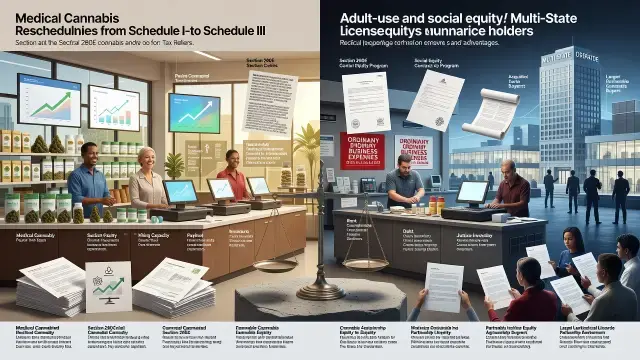
Federal rescheduling has arrived, but only for part of the cannabis industry. In April, qualifying state-licensed medical cannabis moved from Schedule I to Schedule III of the Controlled Substances Act, opening the door to meaningful tax relief for operators who serve medical markets. Adult-use operators, including the social equity license holders many states explicitly prioritized, are still waiting.
Why one tax code section matters so much
The mechanism here is Section 280E, a provision that has shaped cannabis retail economics for years. Under 280E, businesses trafficking in Schedule I or II substances cannot deduct ordinary expenses - payroll, rent, marketing - the way any other retailer would. That means a dispensary can show an operating loss and still owe a sizable tax bill, because the deduction simply isn't available. Rescheduling to Schedule III removes that restriction for qualifying operations. Medical cannabis businesses now have a path out of that trap. Adult-use retailers, absent further federal action, do not.
That sounds like a narrow technical distinction. In practice, it isn't. Tax savings translate directly into hiring capacity, facility upgrades, acquisition budgets and cash reserves. A multi-state operator with qualifying medical revenue gains real breathing room. An independent adult-use shop covering rent, inventory and compliance logs out of thin margins does not. Two companies selling what looks like the same product to the public can now sit on very different financial footing, purely based on license type and geography.
What social equity programs were actually designed to fix
Social equity licensing wasn't an add-on feature of legalization. In states like New York, programs such as the Conditional Adult-Use Retail Dispensary initiative were built to give justice-involved applicants a real head start in the regulated market, recognizing that prohibition's costs fell unevenly. Getting the license was supposed to be the hard part. It wasn't.
Opening a dispensary means permitting, build-out, point-of-sale and seed-to-sale tracking systems, inventory financing, staffing and compliant packaging - easily reaching into the millions before the first sale happens. Staying open is harder still. Retailers compete on brand recognition, wholesale purchasing power and access to capital, while rent, payroll and debt accumulate whether or not revenue keeps pace. Licenses issued and doors opened are easy to count. Whether an entrepreneur still controls that business five years later, or has any equity left in it, is a different question entirely - and one states have been slow to track.
When partnership becomes an exit ramp
Not every capital partnership is a problem; plenty of equity operators need outside investment, real estate and operational expertise to survive. The concern is what the terms look like once the ink dries. An owner may hold the license on paper while a partner controls decisions, extracts fees, or takes the larger share of profit. When sales decline or debt mounts, that owner may have one option left: sell the business, its assets or its interest in the license - often to a better-capitalized buyer, for far less than it's worth. The license holder loses a business built from nothing. The acquirer gains a foothold in the market at a discount. Nothing here requires bad intent; financial pressure alone can produce that outcome.
What a fairer transition would require
Closing this gap takes more than extending 280E relief to adult-use businesses, though Congress addressing that remains the clearest lever available. States issuing equity licenses should also track long-term survival rates, debt loads and ownership changes - not just licenses awarded. Useful steps would include:
- Ongoing access to affordable financing, accounting and compliance support beyond the initial licensing stage
- Clear disclosure requirements in partnership agreements covering fees, decision-making authority and profit splits
- State-level reporting on whether equity license holders retain meaningful ownership over time
Cannabis is moving toward heavier investment, pharmaceutical-style research and consolidation - that trajectory isn't inherently at odds with equity. But if the people legalization was meant to prioritize can't hold onto what they built, rescheduling will have fixed a tax problem while leaving the fairness problem exactly where it started.