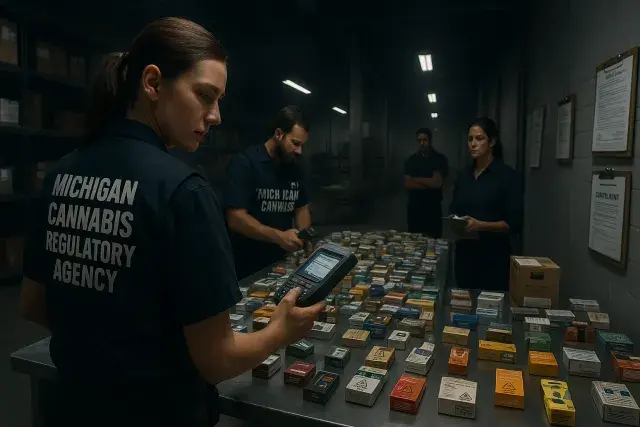
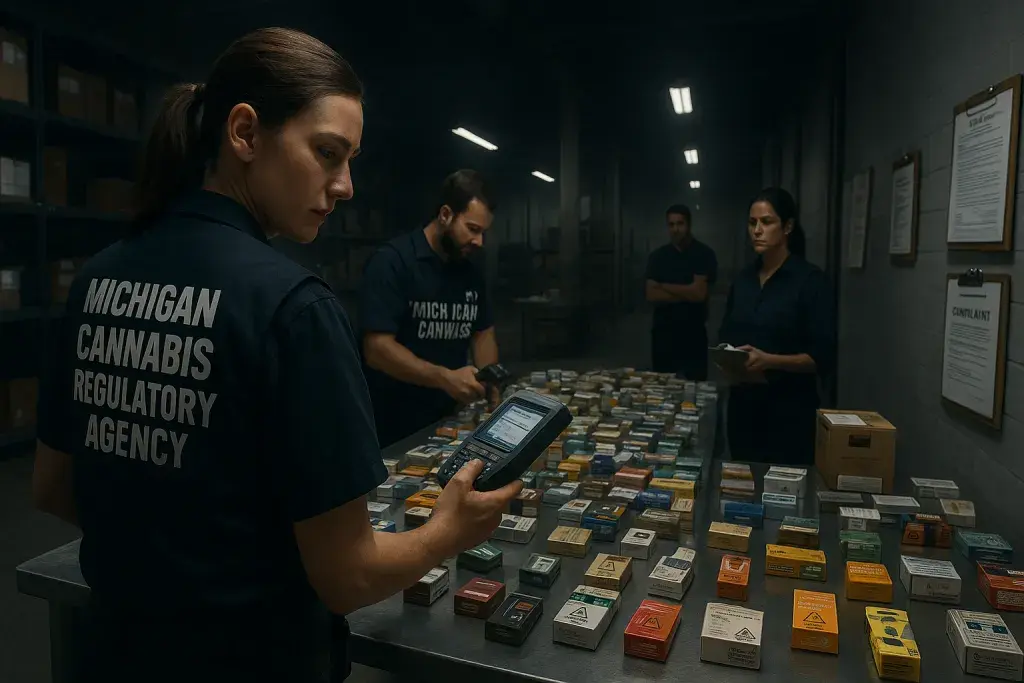
Michigan's Cannabis Regulatory Agency has filed a formal complaint against VJAS 1, a licensed cannabis processor operating in Harrison Township, after an inspection uncovered more than 12,000 individual cannabis products with no Metrc tags or other identifying information. Among the untagged inventory were products in California-specific packaging - bearing the letters "CA" and California-mandated warning language - raising the question of whether unlicensed, out-of-state cannabis had entered a licensed Michigan facility. VJAS 1 now faces fines and potential suspension, restriction, or revocation of its license.
The operational red flags here go well beyond a recordkeeping slip. Seed-to-sale tracking through Metrc is the foundational compliance mechanism in Michigan's regulated market - every product batch, transfer, and sale is supposed to generate a corresponding tag that ties inventory to a licensed origin. Twelve thousand untagged units is not a clerical gap; it's a systemic breakdown. What made the inspection results more serious: investigators found that some products did carry valid Metrc tags, but cross-referencing those tags revealed the inventory was supposed to be physically located at other licensed cannabis businesses entirely. That pattern - tagged product appearing where it shouldn't be - suggests potential diversion, not just disorganization. Operators who want to understand how real-time inventory reconciliation tools, from dispensary pos systems new york to Michigan-specific platforms, can prevent these kinds of discrepancies would do well to study this case as a compliance object lesson.
Employees at the facility reportedly could not explain how or why the untagged products were present. That detail carries its own weight. In a regulated cannabis operation, inventory accountability isn't optional institutional knowledge - it's a basic expectation at every level of staffing. When inspectors arrive and no one on the floor can account for thousands of SKUs, that's not just a compliance failure; it's an indication that internal controls either don't exist or aren't functioning. Regulators across multiple state markets have made clear that ignorance of inventory status is not a mitigating defense.
What California Packaging in a Michigan Facility Actually Signals
The presence of California-compliant packaging in Harrison Township is worth examining closely. California operates its own seed-to-sale tracking system and mandates specific labeling - including warning language, universal symbols, and child-resistant packaging standards - that differs in meaningful ways from Michigan's requirements. Products packaged for the California market are not licensed for sale in Michigan. Full stop. The appearance of that packaging inside a Michigan-licensed processor suggests one of a limited number of explanations: products were sourced from California's regulated or unregulated market, product was diverted across state lines, or someone was using California packaging to obscure product origin. None of those scenarios is benign under Michigan law or federal interstate commerce rules.
Interstate cannabis commerce remains federally prohibited. A licensed Michigan processor accepting product sourced from another state - regardless of whether that source state is also a regulated market - is not operating within the bounds of its license. That's not a technicality. It goes to the fundamental premise of state-licensed cannabis markets: supply chain integrity depends on every product being traceable to a licensed Michigan cultivator or manufacturer from the point of origin forward.
License Risk and What Operators Should Take Away
The CRA's complaint puts VJAS 1 in a position where its operating license is genuinely at risk. Suspension, revocation, and refusal to renew are all on the table - and in a capital-intensive business like cannabis processing, any of those outcomes carries significant financial consequence. Equipment, lease obligations, employee payroll, wholesale relationships: all of it becomes exposed the moment a license is suspended or pulled.
For other Michigan licensees - and for operators in any state market with Metrc or comparable tracking requirements - this case is a practical reminder of what compliance infrastructure actually has to do. It isn't enough to have Metrc access. Inventory reconciliation needs to happen on a regular cadence, not just at the moment a state inspector walks through the door. Products received from any source should be tagged and logged before they move anywhere in the facility. And packaging - even for products that won't be sold - should never come from a non-Michigan-licensed source or carry another state's regulatory markings.
The thing is, compliance in cannabis processing is not especially complicated in concept. The rules around Metrc tagging, chain of custody, and licensed sourcing are clearly defined. What creates risk is the gap between knowing the rules and actually building internal systems - staff training, intake procedures, regular inventory audits - that make compliance routine rather than reactive. VJAS 1's situation appears to be a case where that gap grew large enough to catch a regulator's attention in the worst possible way.
Broader Implications for Michigan's Market
Michigan has one of the more active licensed cannabis markets in the country, and its regulatory agency has shown a consistent willingness to pursue enforcement action when supply chain integrity appears compromised. Cases like this one send a message to the broader processor and retail community: inspections are real, cross-referencing Metrc data against physical inventory is a standard investigative tool, and the burden of explaining every unit in a facility falls on the licensee.
For wholesalers, brands, and other businesses supplying Michigan's licensed market, there's also a downstream consideration. Doing business with a processor that loses its license - or that is found to have handled unlicensed or out-of-state product - creates reputational and compliance exposure for anyone whose Metrc-tagged product appeared in that facility. Due diligence on trading partners is not a formality in a regulated market. It's part of protecting your own license.