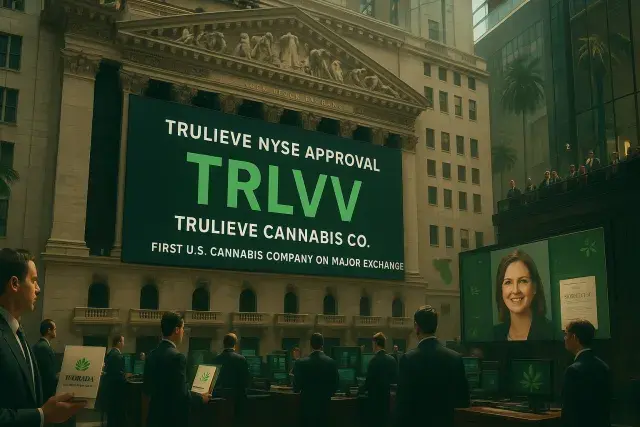
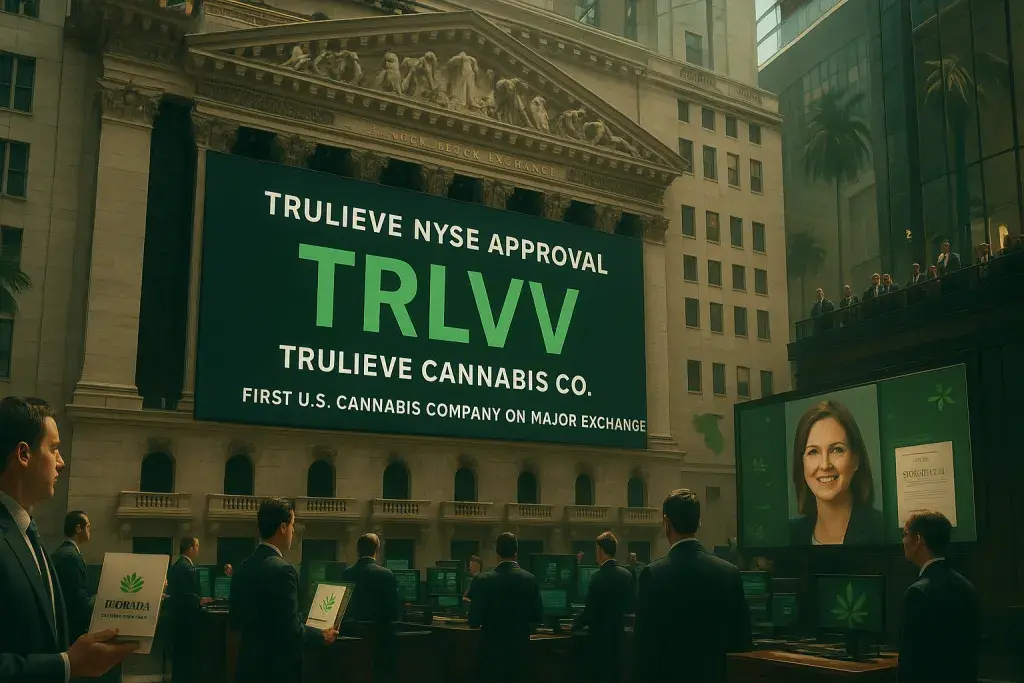
Trulieve Cannabis Co. has received approval to list on the New York Stock Exchange, with voting shares set to begin trading under the ticker symbol TRLV - a first for any U.S.-licensed cannabis company on a major domestic exchange. The milestone arrives at a moment when the broader regulatory environment is shifting in meaningful ways, following Acting Attorney General Todd Blanche's reclassification of medical marijuana to Schedule III in April. For an industry that has spent years locked out of mainstream capital markets, this is not a symbolic gesture. It's a structural change with real financial consequences.
The Schedule III reclassification matters here beyond the headline. Under Schedule I, cannabis businesses faced the full weight of 280E - the federal tax provision that bars companies trafficking in controlled substances from deducting ordinary business expenses, a burden that has squeezed dispensary operators from Florida to Oregon and made profitability a grinding challenge even for high-revenue multi-state operators. Schedule III status doesn't automatically dissolve that burden, but it opens a pathway for Drug Enforcement Administration registration for state-licensed medical marijuana companies, which in turn creates conditions that major U.S. exchanges require before a cannabis company can list. That's the mechanism that unlocked Trulieve's NYSE approval. Operators tracking parallel shifts in retail compliance infrastructure - from cannabis point of sale vermont systems to seed-to-sale tracking integrations - understand that federal scheduling status ripples through every layer of the operational stack, not just capital markets access.
Trulieve has been traded on the Canadian Securities Exchange since 2018, a common workaround for U.S. cannabis companies blocked from domestic major exchanges. That listing closes at the end of Tuesday's market session. The move to the NYSE expands the company's potential shareholder base considerably - institutional investors and index funds that are restricted from holding securities not listed on major U.S. exchanges now have a cleaner path in. CEO Kim Rivers framed it plainly: broader shareholder access, increased liquidity, and elevated visibility for medical marijuana as a legitimate health-care category. What she didn't overstate is how much work remains to make that case to investors who still carry federal-risk hesitation.
Florida Politics and Trulieve's Unfinished Recreational Push
Florida's regulatory environment gives this listing additional context worth understanding. Trulieve provided the financial backbone behind Smart & Safe Florida, the advocacy effort that placed adult-use cannabis on the state's 2024 ballot. The measure pulled nearly 56% support - a meaningful number, but short of the 60% supermajority Florida requires to amend its constitution through citizen initiative. A second push followed, aimed at getting recreational cannabis back on the November 2025 ballot. That effort ended in March when the Florida Supreme Court declined to rehear Smart & Safe's lawsuit against Secretary of State Cord Byrd, who had directed the invalidation of more than 70,000 petition signatures the campaign had collected.
The thing is, Trulieve's business in Florida is built entirely on the state's medical marijuana framework - a vertically integrated model in which the company controls cultivation, processing, and retail dispensing under a single license structure. An adult-use expansion would have dramatically changed the revenue calculus. Without it, the company's Florida growth is constrained by the existing medical patient population and whatever regulatory reforms the legislature is willing to advance. That's a meaningful ceiling for any operator running a large dispensary footprint in a single-state-dominant position. Investors coming through the NYSE will be pricing that ceiling into their models.
What This Means for the Broader Cannabis Business Community
For multi-state operators, wholesalers, cannabis retail technology vendors, and compliance professionals watching this listing, the practical implications cut several ways. First, NYSE access will make it easier for Trulieve to raise capital at lower cost than the Canadian exchange or over-the-counter markets have historically allowed - which means potential for acquisition activity, store expansion, or balance sheet restructuring. Second, the reputational effect of a major U.S. exchange listing signals to institutional money that at least some cannabis companies now meet the compliance and transparency thresholds that sophisticated investors demand.
In practice, though, a single listing doesn't resolve the structural friction that cannabis operators deal with every day. Banking access remains constrained for most licensed businesses. Payment processing is still a patchwork of workarounds. Federal illegality continues to create complications for everything from insurance to interstate commerce. Trulieve's NYSE listing doesn't fix any of that - but it does mark a line in the policy timeline that operators, investors, and regulators will reference as the industry's relationship with federal institutions continues to shift.
One listing. Meaningful. Not the whole story.