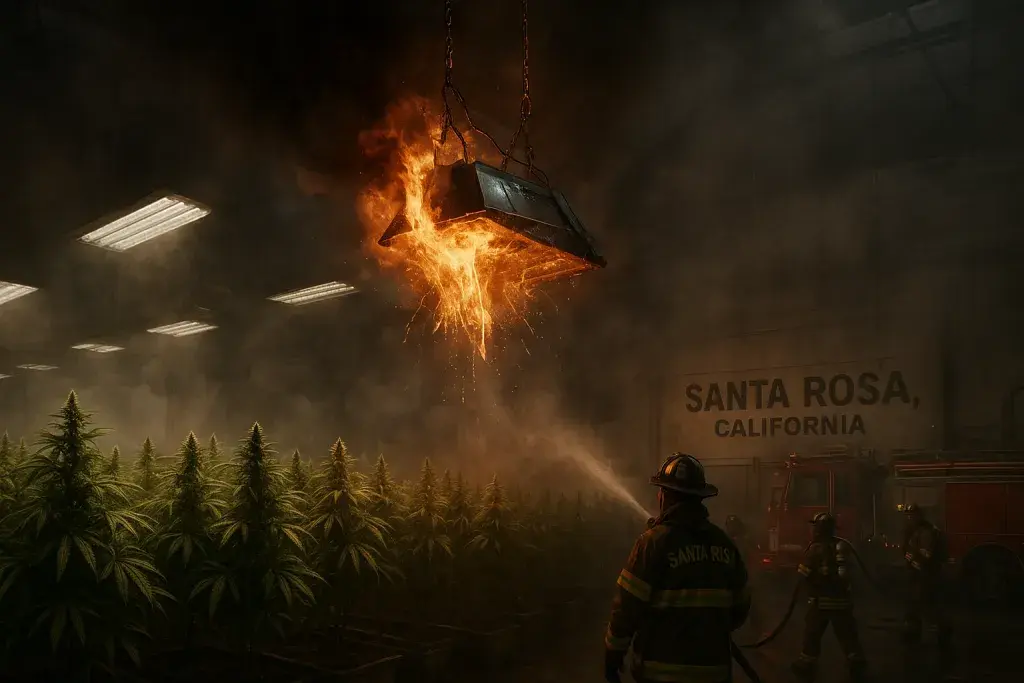
A broken light fixture ignited a fire Tuesday inside a permitted cannabis grow room at a warehouse complex on Giffen Avenue in Santa Rosa, California, causing an estimated $180,000 in damage to the building and its contents, fire officials confirmed Wednesday, July 8. The blaze, reported shortly after 11:50 a.m., was contained within roughly 20 minutes - but smoke damage accounted for the bulk of the loss, according to Paul Lowenthal, the city's division chief fire marshal. No injuries were reported.
The incident points to a risk that licensed cannabis operators across the country don't always price into their operational planning: grow room infrastructure, particularly high-intensity lighting systems, is a persistent fire hazard when poorly maintained or improperly installed. That calculus applies well beyond California. Operators building out commercial cultivation facilities in other regulated markets - including those sourcing compliant cannabis POS in Nevada and integrating track-and-trace requirements across their supply chain - face the same underlying exposure. A cultivation facility fire doesn't just damage property; it can knock out inventory that's already been logged into seed-to-sale systems, creating compliance headaches on top of financial ones.
The Santa Rosa facility, which houses multiple cannabis-growing operations, was not red- or yellow-tagged following the fire, meaning regulators have not restricted its use. That's a meaningful distinction for operators at the site. A red tag would halt all operations; a yellow tag would impose conditions on re-entry or continued use. Neither applied here, which suggests the structural integrity of the building remained intact - and that the damage, while costly, was concentrated rather than catastrophic. Twenty-three personnel from Santa Rosa Fire responded, including three engines, a ladder truck, a heavy rescue unit, a squad, two battalion chiefs, and a fire investigator.
Grow Room Lighting: The Risk That Comes with the Business
Commercial cannabis cultivation depends on high-output artificial lighting - high-pressure sodium, metal halide, and increasingly LED systems - running for extended daily cycles. These systems generate significant heat. When fixtures degrade, are improperly wired, or fail mechanically, the combination of heat, dry growing media, and combustible materials in a typical grow room creates real fire potential. That's not a hypothetical; it's what happened on Giffen Avenue.
What's striking here is that this fire occurred at a permitted facility - one operating within the licensed framework Santa Rosa has established for commercial cannabis. Permitted status means the operation passed a licensing review, but it doesn't guarantee ongoing equipment integrity. Inspections happen at defined intervals; equipment fails between them. The gap between compliance on paper and operational safety in practice is exactly where incidents like this one occur.
For multi-site operators, the financial exposure compounds quickly. Smoke damage - which Lowenthal identified as the primary driver of the $180,000 estimate - can affect grow rooms adjacent to the ignition point, contaminate HVAC systems shared across a warehouse complex, and render harvested plant material unsalable. If that inventory has already been assigned batch numbers and entered into METRC or a comparable seed-to-sale tracking system, operators face the additional administrative burden of reconciling destroyed product through the state's compliance infrastructure. That process is not automatic, and it isn't fast.
What Operators Should Take From This
A single broken fixture causing six figures in losses is a reminder that facility maintenance is not a back-burner item. A few operational realities are worth keeping in mind:
- Lighting system inspections should be scheduled proactively, not triggered by visible failure. Fixtures in high-humidity grow environments degrade faster than standard commercial lighting.
- Fire suppression systems inside grow rooms - not just in corridors or common areas - can significantly limit damage containment time. Twenty minutes is a reasonable suppression window; without early detection, it wouldn't be.
- Cannabis-specific commercial property insurance is not uniform. Coverage for plant material, grow equipment, and business interruption varies considerably by policy, and many standard commercial policies exclude or limit cannabis inventory losses. Operators should review coverage terms before an incident, not after.
- In a multi-tenant cannabis warehouse complex, one tenant's fire event creates exposure for neighboring operations - through smoke infiltration, water damage from suppression, and potential shared-tag outcomes if the building's common systems are affected.
The Giffen Avenue fire is, by cannabis industry standards, a contained incident. No one was hurt. The building wasn't tagged. Operations can presumably resume. But $180,000 in losses from a single broken fixture - in a facility that was operating legally and within regulatory bounds - is a concrete illustration of the gap between licensed compliance and operational risk management. Those are two different disciplines, and conflating them is expensive.